

29 Apr How Much Do Movable Glass Partitions Cost?
How Much Do Movable Glass Partitions Cost?
Content basis: This guide is based on INDEE project experience with movable glass partitions, acoustic glass walls, operable wall systems, hotel ballroom partitions, and convention center movable walls for overseas commercial projects.
Last updated: April 2026. Final pricing should be confirmed with project drawings, opening dimensions, acoustic requirements, finish selections, shipping scope, and local installation conditions.
For most commercial projects, movable glass partitions cost is not a single product price. It is the result of system type, opening size, acoustic target, glass specification, frame detail, track and parking design, hardware, packaging, freight, and installation responsibility. A serious supplier should be able to explain these cost drivers before giving a final quotation.
This is especially important for overseas B2B buyers in the United States, Europe, and export markets. Architects, contractors, office fit-out companies, dealers, and project owners often need an early budget for planning, but the final price should still be based on drawings and site conditions. Otherwise, the project may look more economical at quotation stage and become more expensive during coordination.
Quick answer: cost depends on the complete partition system
An entry-level option is usually a simple fixed glass partition with standard height, standard glass, and a straightforward frame. A movable glass partition costs more because it must move, seal, align, park, and remain stable after repeated use. Acoustic movable glass systems, fire-rated glass partitions, ultra-high operable walls, and custom finishes increase the cost further because they require stronger engineering and more careful installation coordination.
For an accurate quotation, INDEE normally needs the clear opening width and height, plan drawings, ceiling condition, acoustic target, preferred glass or panel finish, frame color, parking direction, door requirements, project country, and whether the buyer needs supply only or supply with installation guidance.
1. System type is the first cost decision
A slim fixed glass wall, a double-glazed acoustic partition, and a movable glass partition are not priced the same way because they solve different problems. Fixed glass is mainly a room-division and design product. Movable glass is a flexible-space system. It must include track, carriers, seals, locking or closure details, and a parking solution.
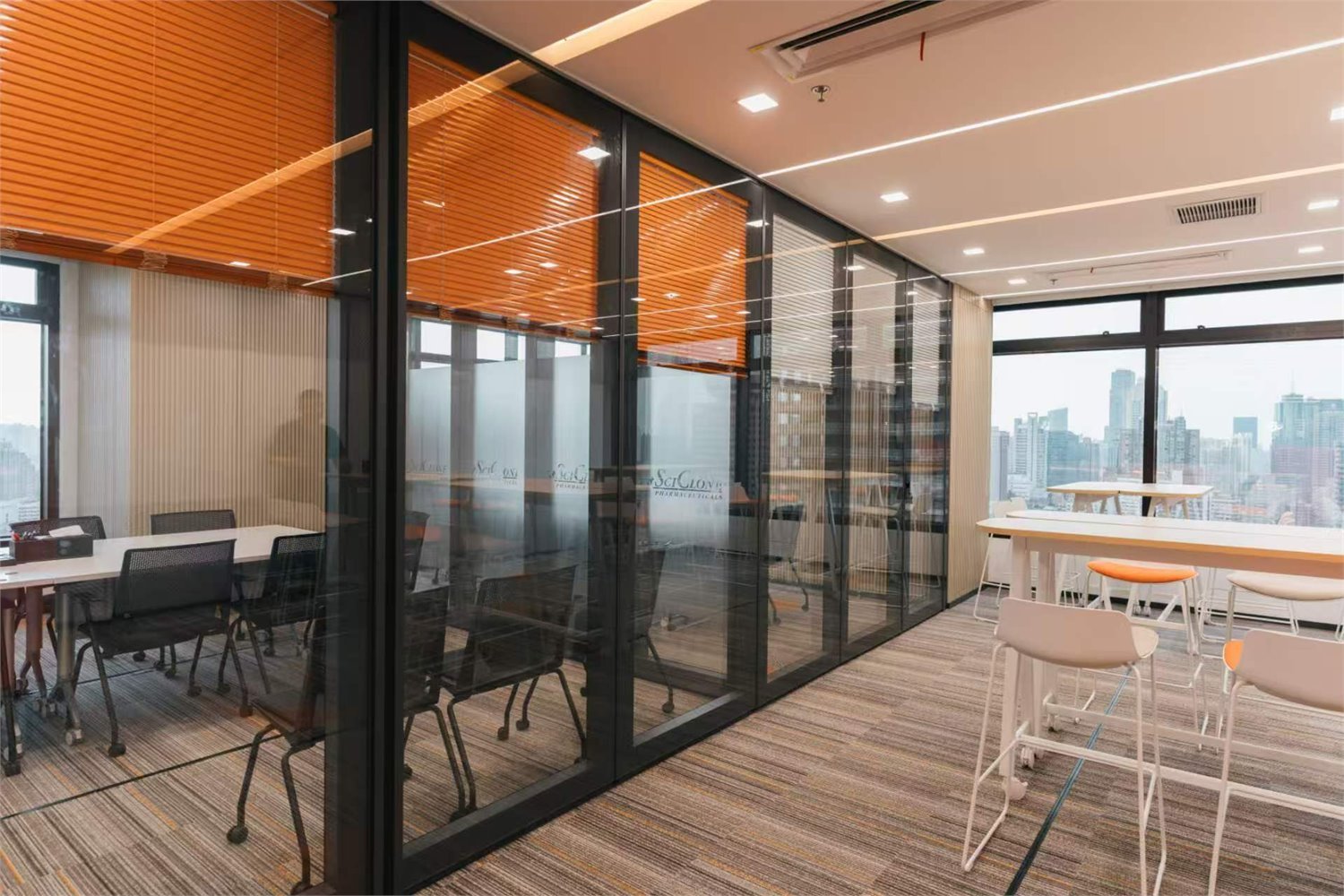
For example, the SciClone Pharmaceuticals Shanghai Office project used an INDEE 90 double-glazed hidden-frame operable partition wall with a 45 dB target, about 3 m height, and about 15 m opening width. That type of system is different from a standard fixed glass room because the buyer is paying for flexibility, acoustic control, movement, and long-term operation.
| Cost driver | Lower-cost direction | Higher-cost direction |
|---|---|---|
| System type | Fixed slim glass partition | Movable glass partition or operable acoustic wall |
| Glass specification | Single tempered glass | Double-glazed, laminated, acoustic, or fire-rated glass |
| Acoustic target | Visual division or moderate privacy | Higher STC target with stronger seals and assembly details |
| Opening size | Standard office height and short runs | Wide openings, tall openings, or multi-zone layouts |
| Track and parking | Simple straight layout | Curved tracks, storage pockets, intersecting tracks, or complex parking |
| Scope | Factory supply only | Shop drawings, packing, freight, technical support, and installation coordination |
2. Acoustic performance changes the quotation
Acoustic performance is one of the biggest reasons two glass partition quotations can look very different. A meeting room that only needs visual privacy does not need the same system as an executive office, hotel ballroom, or divisible convention hall.
Office references such as Canon China Office and other corporate projects often sit around the 44-45 dB range. Larger flexible spaces may need stronger targets. The Xuzhou Fantawild Boonie Bears Hotel reference used a hotel ballroom operable wall with a 53 dB target. Shaoxing Convention Center used an ultra-high operable partition wall with a 55 dB target.
Higher acoustic targets can affect panel thickness, glass layers, frame depth, seal design, track precision, surrounding wall requirements, and installation tolerance. This is why buyers should compare quotations by assembly and performance, not only by square-meter price.
3. Height, width, and panel parking affect material and engineering cost
Opening size changes both product cost and engineering risk. A 3 m high office partition and a 10 m high convention center wall may both be called movable partitions, but they do not use the same structure, track loading, or installation plan.
Panel parking is another cost driver that is easy to miss. If panels need to park inside a pocket, around a corner, or away from an entrance, the track path and hardware become more complex. Poor parking planning can also reduce usable floor area, interfere with MEP systems, or create operational problems for hotel and venue staff.
For this reason, a reliable quotation should ask where the panels go when the room is open. If the supplier does not ask about parking, the initial quote may not include enough hardware, track, or coordination detail.
4. Glass, frame, and finish choices change both price and lead time
Movable glass partitions may use single glass, double glass, laminated glass, acoustic glass, fire-rated glass, frosted or gradient film, powder-coated aluminum frames, hidden-frame profiles, or custom hardware. Each choice affects cost, production time, packing method, and sometimes local approval documentation.
For office projects, the buyer may prioritize transparency, slim profiles, and clean details. For hotel and convention projects, durability, acoustic performance, finish consistency, and service access may be more important. Dealers and contractors should confirm the finish and hardware package early so the quotation can be compared fairly between suppliers.
5. Shipping, duties, and installation scope matter for overseas buyers
Factory price is only one part of the real project cost. Overseas buyers also need to consider export packing, sea or air freight, insurance, local duties or taxes, unloading, storage, installation labor, tools, field measurement, and responsibility for final adjustment.
INDEE can support factory-direct supply and project coordination, but the buyer should clarify the commercial scope. A contractor may only need product supply and technical documents. A dealer may need repeatable packaging, labeling, spare parts, and installation training. A project owner may need a more complete coordination package through the local contractor.
6. What information makes a cost estimate reliable?
The fastest way to get a useful price is to send more than a product name. A good supplier can provide an early budget from basic dimensions, but a serious quotation should be based on project documents.
- Architectural plan showing where the partition will be installed.
- Clear opening width and height, including finished floor and ceiling conditions.
- Target acoustic rating or a description of how the rooms will be used at the same time.
- Preferred glass type, frame color, panel finish, and door or pass-door requirements.
- Track route, panel parking position, and any ceiling conflicts such as lights or sprinklers.
- Project country, expected delivery schedule, and whether local installation is by the buyer, contractor, dealer, or INDEE-supported team.
- Photos or site survey notes if the building already exists.
7. Common mistakes when comparing movable glass partition prices
Many cost problems come from comparing incomplete quotations. One supplier may include acoustic seals, shop drawings, export packing, and technical support. Another may quote only panels and a simple track. The lower price may not be lower after missing items are added.
| Mistake | Why it creates risk | Better approach |
|---|---|---|
| Comparing only square-meter price | It hides differences in glass, seals, track, parking, and scope. | Compare system configuration and included services. |
| Ignoring acoustic target | A visual partition and an acoustic movable wall may look similar in a picture. | Define STC target or simultaneous-use scenario early. |
| Leaving parking until later | Track and storage changes can affect ceiling design and usable area. | Mark the parking zone on plan drawings before quotation. |
| Not confirming installation responsibility | Factory supply, installation guidance, and local installation are different scopes. | Define who measures, installs, adjusts, and signs off. |
| Choosing glass only by upfront price | It may fail privacy, acoustic, safety, or fire-rating expectations. | Match glass specification to the room function and local requirements. |
8. How INDEE approaches a cost-based inquiry
INDEE is a factory-direct manufacturer with long-term OEM and ODM experience for commercial movable partition systems. The quotation process should help the buyer reduce uncertainty, not hide it. For a cost inquiry, INDEE reviews product type, dimensions, acoustic target, glass and frame specification, track and parking, finish, packing, and project country before recommending a system.
This approach is useful for architects who need early design input, contractors who need a comparable bid, dealers who need repeatable product packages, and project buyers who want to avoid weak specifications. The most useful question is not “Which partition has the smallest upfront quote?” It is “Which partition system fits this opening, use case, acoustic target, and delivery scope?”
Related INDEE guides and project references
- Glass Office Partitions: Acoustic, Fire-Rated and Movable Options
- 45 dB vs 55 dB Movable Wall Systems
- Hotel Ballroom Operable Partition Walls
- View INDEE commercial partition projects
- Explore INDEE partition solutions
FAQ: Movable Glass Partition Cost
Can INDEE give a price per square meter for movable glass partitions?
INDEE can provide early budget guidance when the basic project conditions are clear, but a final quotation should be based on drawings, opening size, acoustic target, glass specification, track and parking layout, and project scope. A single square-meter number can be misleading if these details are missing.
Why are acoustic movable glass partitions more expensive than fixed glass walls?
Acoustic movable glass partitions include more engineering. They need glass and frame configuration, moving hardware, top-hung track, seals, alignment details, and a parking solution. Fixed glass walls do not need to move, seal, and park in the same way.
What increases the cost most in a movable partition project?
The largest cost drivers are usually opening size, acoustic target, glass or panel specification, track complexity, parking layout, hardware, finish, freight, and installation responsibility. Ultra-high openings, fire-rated requirements, and custom finishes can increase the cost and lead time.
What should contractors send before requesting a quotation?
Contractors should send plan drawings, sections if available, clear opening dimensions, reflected ceiling information, acoustic target, finish requirements, parking direction, site photos, project country, and expected delivery schedule.
Send drawings for a project-based quotation
If you are budgeting movable glass partitions for an office, hotel, convention center, dealer project, or commercial fit-out, send INDEE the drawings, dimensions, acoustic target, finish preference, and delivery scope. The team can review the project conditions and recommend a system that matches the building instead of giving a generic product price.
