

20 Apr Glass Office Partitions: Acoustic, Fire-Rated and Movable Options
Glass Office Partitions: Acoustic, Fire-Rated and Movable Options
Content basis: This guide is based on INDEE project references, operable partition specifications, and commercial flexible-space project experience.
Last updated: April 2026. Final glass office partition selection should be confirmed with project drawings, site conditions, acoustic targets, and local requirements before quotation.
Quick answer: Glass office partitions should be selected by function. A slim fixed glass wall is not the same as an acoustic meeting room wall, a fire-rated glass partition, or a movable glass wall. Each option has different frame, seal, glass, and approval requirements.
In this guide:
- How to compare fixed, acoustic, fire-rated, and movable glass options.
- Why acoustic privacy depends on more than glass thickness.
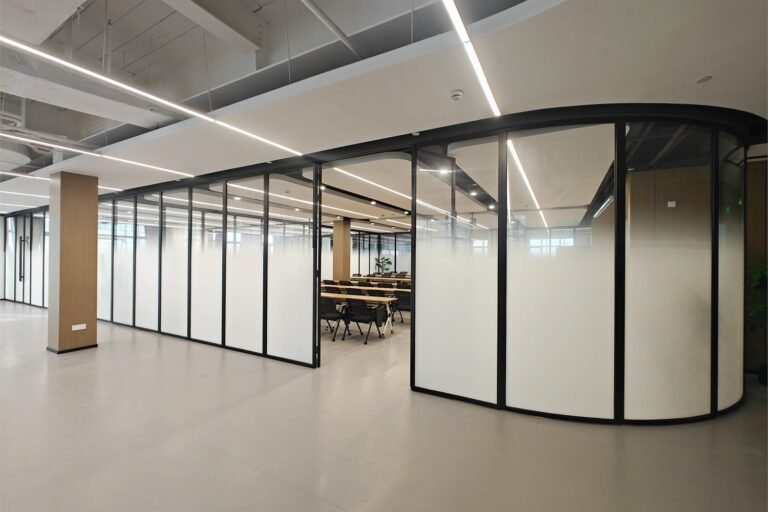
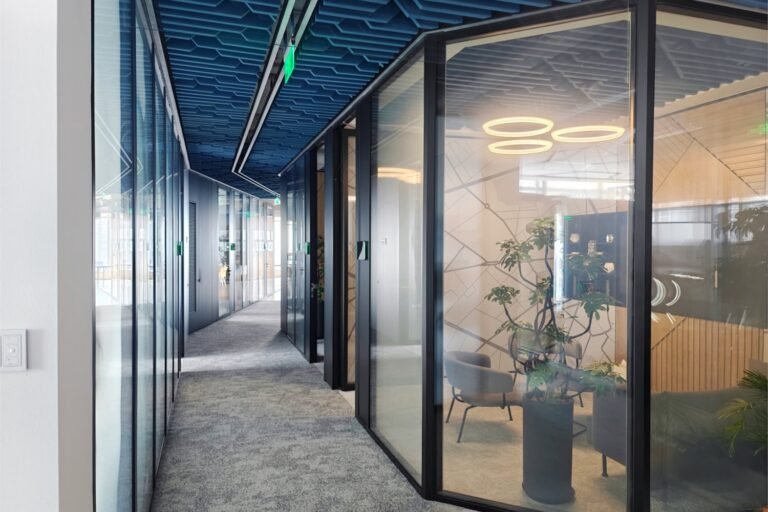
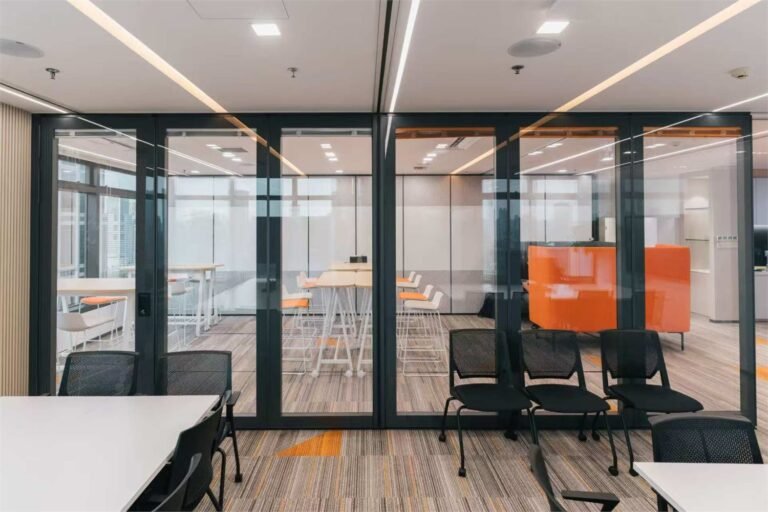
- Project references for corporate offices, medical workplaces, and commercial interiors.
Office glass partitions are often chosen because they look clean and keep visual openness. But in B2B projects, appearance is only one part of the decision. Meeting rooms need speech privacy. Executive rooms may need stronger acoustic control. Fire compartments require certified fire-rated construction. Flexible training rooms may need a movable glass system instead of a fixed wall.
The right specification starts with the space function, not with a generic glass thickness.
Compare the Main Glass Partition Options
| Slim fixed glass partition | Best for open offices, meeting rooms, and visual division. Check frame profile, glass film, door hardware, and basic acoustic expectations. |
|---|---|
| Acoustic glass meeting room | Best for boardrooms and private offices. Check double glazing, seals, door details, ceiling flanking, and room-to-room speech privacy. |
| Fire-rated glass partition | Best for fire separation with visibility. Check certified glass, rated frame, approved hardware, and local code documentation. |
| Movable glass wall | Best when the layout must change while keeping openness. Check track, carriers, parking, seals, panel movement, and acoustic expectation. |
Project References for Glass Office Decisions
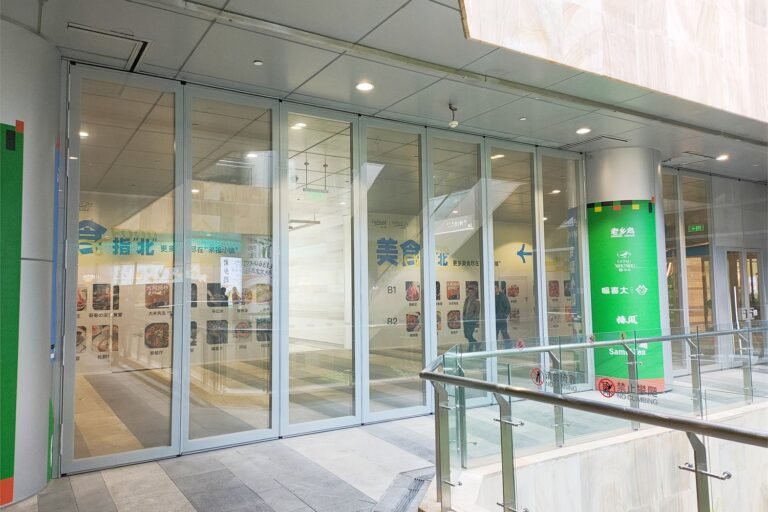
Acoustic Privacy Is Not Automatic
Glass does not automatically provide strong privacy. Acoustic performance depends on glass make-up, air gap, frame design, door seals, top and bottom conditions, and the surrounding ceiling and wall construction. If a meeting room has an open ceiling plenum or poorly sealed door, a high glass specification alone will not solve the problem.
For office projects, INDEE recommends defining the expected use first: normal discussion, confidential meetings, executive office privacy, training room separation, or public corridor separation. Each scenario leads to a different system.
Fire-Rated Glass Requires Evidence
Fire-rated glass partitions are not simply thicker glass. The complete assembly matters: glass, frame, gaskets, hardware, and installation detail. Buyers should confirm whether the project requires a specific rating, whether local approval documents are needed, and whether the door hardware must also be rated.
When fire rating is required, the quotation should clearly separate fire-rated glass scope from ordinary office glass scope. This avoids comparing products that are not technically equivalent.
When to Choose a Movable Glass Wall
A movable glass wall is useful when a space must remain visually open but still change layout. This can apply to training rooms, showrooms, conference rooms, and premium office areas. The main difference from a fixed glass partition is the movement system: track, carriers, panel parking, and seals become part of the specification.
Movable glass walls should be discussed early because panel parking can affect furniture layout, doors, ceiling services, and the final user experience.
Information to Send for a Glass Partition Quote
- Plan drawing with partition line and door locations.
- Finished floor to ceiling height.
- Acoustic privacy expectation or rating target.
- Fire-rating requirement, if any.
- Preferred frame color, profile style, and glass finish.
- Whether the wall is fixed, sliding, folding, or fully movable.
Common Quotation Mistakes for Glass Office Partitions
The most common mistake is comparing different systems as if they were the same product. A slim fixed glass wall, a fire-rated glass partition, and a movable glass wall may all look transparent in a rendering, but the engineering scope and price basis are very different. Buyers should confirm whether the quotation includes doors, hardware, rated frame, acoustic seals, film, finish, track, parking hardware, and installation interface.
The second mistake is ignoring the ceiling. Many office glass partitions fail to deliver the expected privacy because sound travels through the ceiling void, an unsealed door perimeter, or a weak junction with drywall. A serious supplier should ask about these conditions instead of quoting glass thickness only.
How to Make the Proposal Comparable
| System type | Confirm whether the offer is fixed glass, sliding glass, movable glass, acoustic glass, or fire-rated glass. |
|---|---|
| Performance target | Separate acoustic privacy, fire rating, visual finish, and movement requirements. Do not assume one requirement covers another. |
| Included scope | Check doors, locks, handles, tracks, frames, seals, glass type, film, finish, installation, and documentation. |
| Interface risk | Review ceiling, floor, side walls, MEP penetrations, and door locations before treating the quotation as final. |
FAQ: Glass Office Partitions
Is glass suitable for confidential meeting rooms?
Yes, but only when the complete system is designed for acoustic privacy. Door seals, ceiling conditions, and junction details matter as much as glass type.
Can fire-rated glass also be acoustic?
It can be designed with acoustic requirements in mind, but fire rating and acoustic performance must both be confirmed. Do not assume one automatically includes the other.
Should I choose fixed glass or movable glass?
Choose fixed glass when the room layout is stable. Choose movable glass when the same area must serve different functions and visual openness still matters.
Send Drawings for a Project-Based Recommendation
INDEE can review opening dimensions, ceiling conditions, acoustic targets, panel parking, finish requirements, and operation expectations before recommending a system. This helps the quotation match the building instead of becoming only a square-meter price.
