

20 Apr 45 dB vs 55 dB Movable Wall Systems
45 dB vs 55 dB Movable Wall Systems
Content basis: This guide is based on INDEE project records, operable partition specifications, and commercial flexible-space project experience.
Last updated: April 2026. Final acoustic and system selection should be confirmed with project drawings, site conditions, and local requirements before quotation.
Quick answer: 45 dB is often enough for many office privacy needs, while 53-55 dB is more relevant for hotels, convention centers, and simultaneous event use.
In this guide:
- Where 44-45 dB office references make sense.
- Where stronger 53-55 dB systems become important.
- How to judge whether an acoustic quotation is serious.
Acoustic ratings are often presented as simple numbers on a quotation sheet. In reality, 45 dB vs 55 dB movable wall systems is not a question of good or bad. It is a question of application, building condition, budget, and how much acoustic privacy the client expects in daily use.
For B2B buyers, the biggest risk is buying a number without understanding the complete assembly behind it. A high target rating still depends on seals, track alignment, panel joints, side jambs, floor levelness, and surrounding wall construction.
1. What the Rating Should Tell You
A movable wall rating should describe the intended acoustic performance of a system, not just the weight of a panel. It should help the buyer decide whether the product is suitable for normal speech privacy, executive office meetings, hotel banquet separation, convention sessions, or a louder event environment.
- A lower target may be enough when the room is used for normal office speech.
- A stronger target is often needed when adjacent rooms hold simultaneous events.
- The surrounding construction must support the target, otherwise the wall rating loses practical meaning.
- Installation quality matters because a small acoustic gap can reduce real performance.
2. Where 44-45 dB Is Common
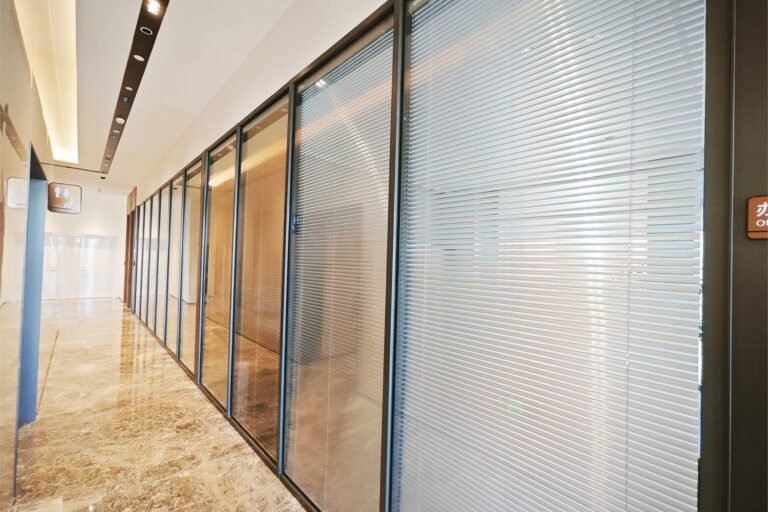
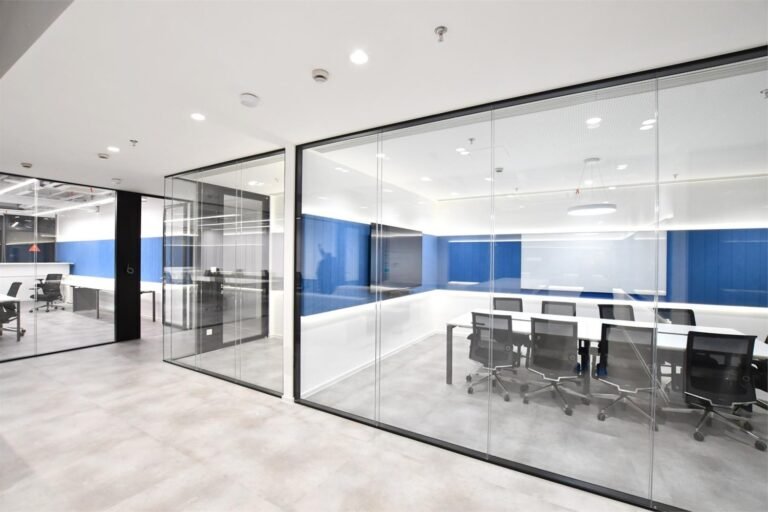
Many office and glass partition projects fall around the 44-45 dB range. In INDEE project data, Guosheng Tower Office used an INDEE 84 glass partition wall with about 44 dB. Atlas Copco Songjiang Office and Canon China Office used INDEE 90 style systems around 45 dB.
This range is often suitable for meeting rooms, executive offices, everyday workplace privacy, and corporate office applications where the main goal is to reduce normal speech transfer. It is not always intended to isolate louder banquet, exhibition, or large public venue activity.
| Guosheng Tower Office | INDEE 84 glass partition wall, 44 dB target, 2.8 m height. |
|---|---|
| Atlas Copco Songjiang Office | INDEE 90 glass partition wall, 45 dB target, 2.9 m height. |
| Canon China Office | INDEE 90 glass partition wall, 45 dB target, 3 m height. |
3. Where 53-55 dB Becomes More Important
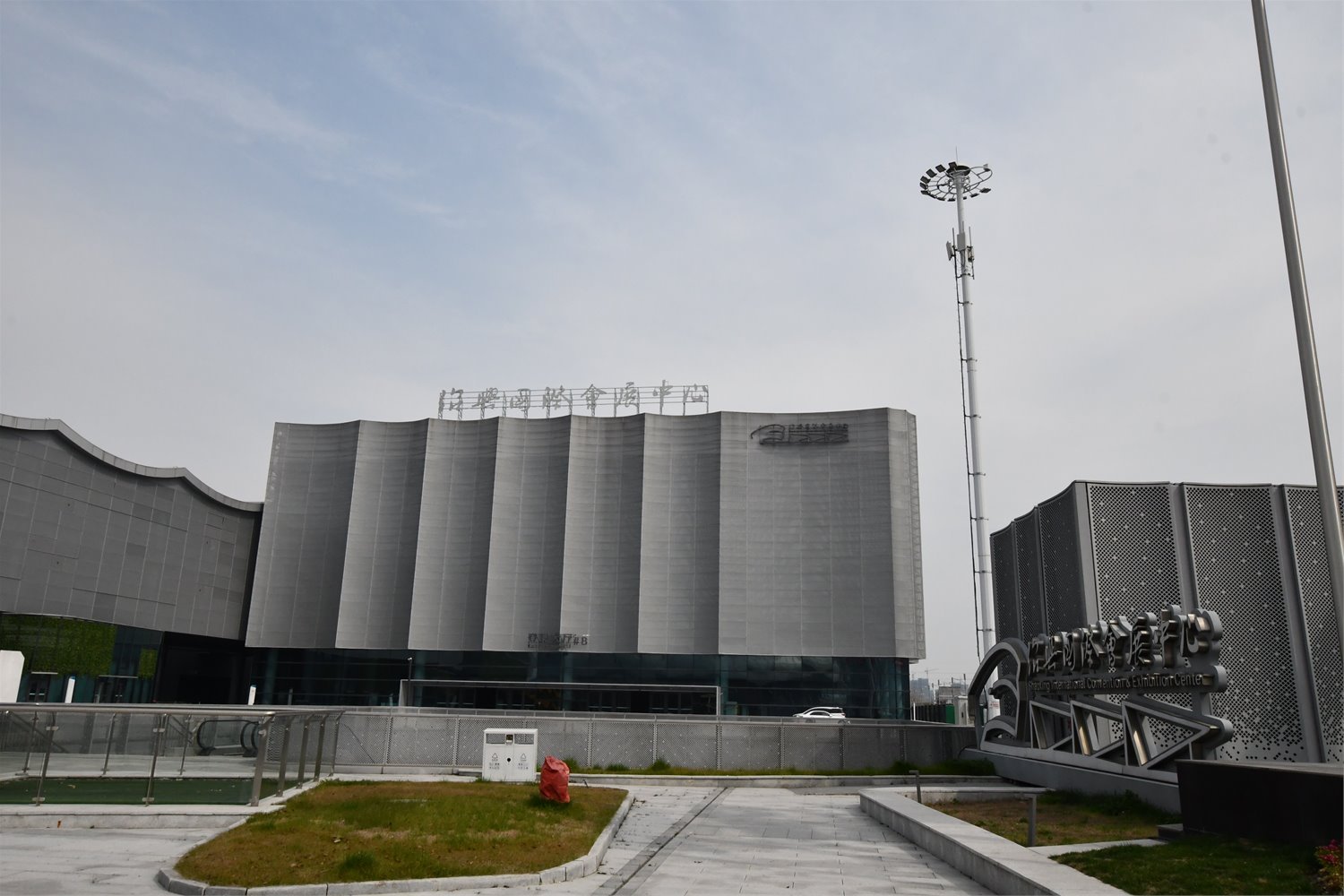
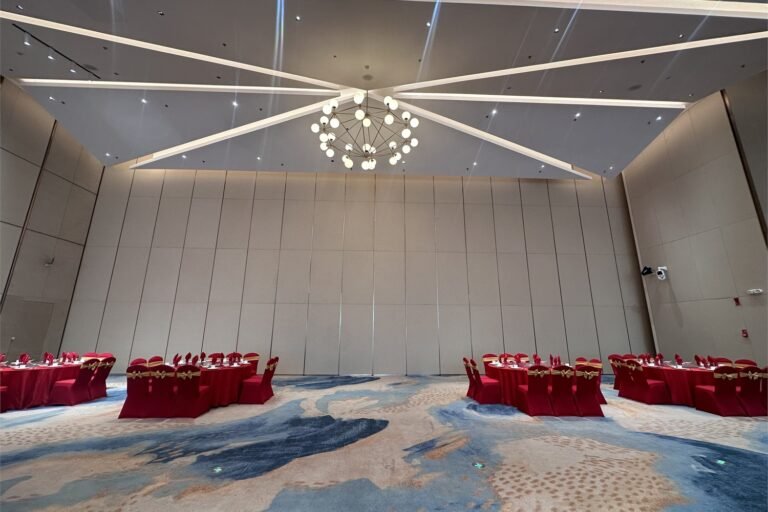
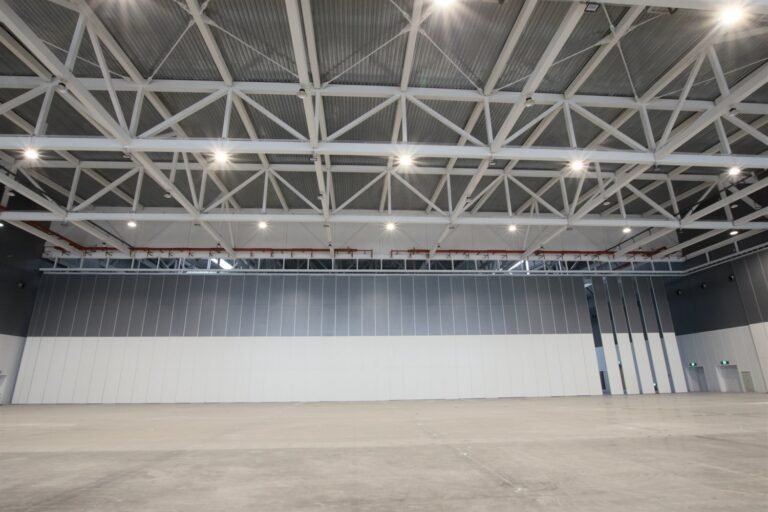
Large event spaces need stronger acoustic separation because the room volume, sound energy, and user expectation are different. The Xuzhou Fantawild Boonie Bears Hotel ballroom reference used a target around 53 dB, with an opening about 8.5 m high x 23 m wide. Shaoxing Convention Center and Yancheng Yellow Sea Wetland Convention Center reached about 55 dB for ultra-high public venue applications.
In these situations, the wall may need to separate two conferences, a banquet and a meeting, or parallel exhibition functions. A visually acceptable wall may still create complaints if the acoustic target is too low for the operating scenario.
| Hotel ballroom reference | INDEE 97 operable partition wall, 53 dB target, 8.5 m high x 23 m wide. |
|---|---|
| Convention center reference | INDEE 100 ultra-high operable partition wall, 55 dB target, 10 m high x 36 m wide. |
| Public venue reference | INDEE 100 ultra-high operable partition wall, 55 dB target, 10 m high x 32 m wide. |
4. Do Not Buy the Number Alone
A high rating does not automatically guarantee a quiet room. If the surrounding fixed wall is weak, if the floor is uneven, if the top seal does not close correctly, or if the side jamb is not coordinated, the final performance can be lower than expected.
- Ask whether the stated value is a tested assembly value, a project target, or a supplier estimate.
- Confirm the panel thickness, seal type, frame detail, and track system included in the quotation.
- Check whether the surrounding walls, ceiling, and floor can support the target.
- Ask how the system will be commissioned and adjusted after installation.
5. Selection Matrix for B2B Buyers
| Corporate offices | Often around 44-45 dB when the goal is normal meeting privacy and speech reduction. |
|---|---|
| Executive meeting rooms | May need stronger glass or solid partition details depending on privacy expectations. |
| Hotel ballrooms | Often require a stronger target when adjacent events run at the same time. |
| Convention centers | Usually require early acoustic, track, parking, and ceiling coordination, especially for ultra-high walls. |
| Clean rooms / archives | Acoustic rating may not be the only performance issue; sealing, access, and operational constraints can matter more. |
6. Quotation Questions That Reveal Supplier Quality
- What exact panel system and seal configuration are included?
- What site conditions are required to reach the target?
- How are side jambs, top seals, and floor contact handled?
- What drawings are needed before final pricing?
- How is panel parking planned and how does it affect acoustic sealing?
- What installation guidance, adjustment, and operation training are provided?
How to Judge Whether a movable wall acoustic Proposal Is Serious
A professional partition proposal should do more than repeat a product name and a square-meter price. For commercial projects, the supplier should connect the system selection to drawings, opening dimensions, acoustic target, finish expectations, operation method, panel parking, and installation conditions.
If a supplier can only quote from a rough area number, the price may still be useful for early budgeting, but it should not be treated as a final technical proposal. The final recommendation should explain why a certain system, frame depth, track route, seal configuration, glass or panel specification, and finish package is suitable for the project.
| Budget price | Useful for early feasibility, but usually based on limited information and should be treated as a rough reference. |
|---|---|
| Technical proposal | Should be based on drawings, opening dimensions, acoustic target, operation method, finish, parking, and interface conditions. |
| Engineering review | Should identify risks such as ceiling conflicts, weak surrounding construction, insufficient parking space, or unclear door/hardware details. |
| Quotation confidence | Improves when the buyer provides plans, sections, reflected ceiling drawings, site photos, and required performance targets. |
This is also why INDEE prefers drawing-based communication before final pricing. A more careful early review reduces later design changes, acoustic disappointment, installation conflict, and unclear responsibility between supplier, contractor, and project owner.
7. Related INDEE Project References
FAQ: 45 dB vs 55 dB Movable Wall Systems
Is 55 dB always better than 45 dB?
No. A stronger rating can be useful for large venues or simultaneous event use, but it may be unnecessary for ordinary office privacy. The right target should match the room use, surrounding construction, and budget.
Why can the final result be lower than the quoted number?
The final acoustic result depends on the full assembly: panels, seals, track alignment, side jambs, floor levelness, ceiling conditions, and surrounding fixed walls. Any weak path can reduce practical performance.
What should I send before asking for an acoustic quotation?
Send the opening size, drawings, intended room use, target acoustic rating if available, finish expectations, operation method, panel parking direction, and project location.
Send Drawings for a Project-Based Recommendation
If your project involves hotel ballrooms, convention centers, corporate offices, clean rooms, archives, or other flexible commercial spaces, INDEE can review the opening conditions and recommend a suitable partition system. Share drawings, target acoustic rating, opening size, finish preference, and panel parking requirements so the proposal matches the actual building instead of a generic product list.
