

20 Apr Steel Partition Wall Systems for Commercial Interiors
Steel Partition Wall Systems for Commercial Interiors
Content basis: This guide is based on INDEE project records, operable partition specifications, and commercial flexible-space project experience.
Last updated: April 2026. Final acoustic and system selection should be confirmed with project drawings, site conditions, and local requirements before quotation.
Quick answer: Steel partition systems are best evaluated by durability, acoustic privacy, finish maintenance, door/interface details, and whether the room needs a solid modular wall rather than transparency.
In this guide:
- When steel partitions make sense in commercial interiors.
- How the PipeChina office reference informs specification.
- What to confirm before comparing steel partition quotations.
Steel partition wall systems are useful when a commercial interior needs durability, clean panel alignment, a stronger solid-wall feeling, or a more controlled technical appearance than ordinary gypsum board or glass partitions. They can be used in corporate offices, public facilities, archives, technical rooms, and spaces where maintenance and long-term performance matter.
For B2B buyers, the key is to avoid treating a steel partition as a simple decorative panel. Frame depth, panel material, acoustic target, door details, surface finish, installation tolerance, and site conditions should all be reviewed before quotation.
1. When Steel Partitions Make Sense
- The project needs a more solid and durable partition surface than glass.
- The client wants clean modular alignment and replaceable panels.
- The room needs acoustic privacy but does not require full transparency.
- The space includes technical, archive, management, or public-service functions.
- The design language requires metal, powder-coated, or more industrial details.
2. Real Project Reference: PipeChina Shanghai Branch Office
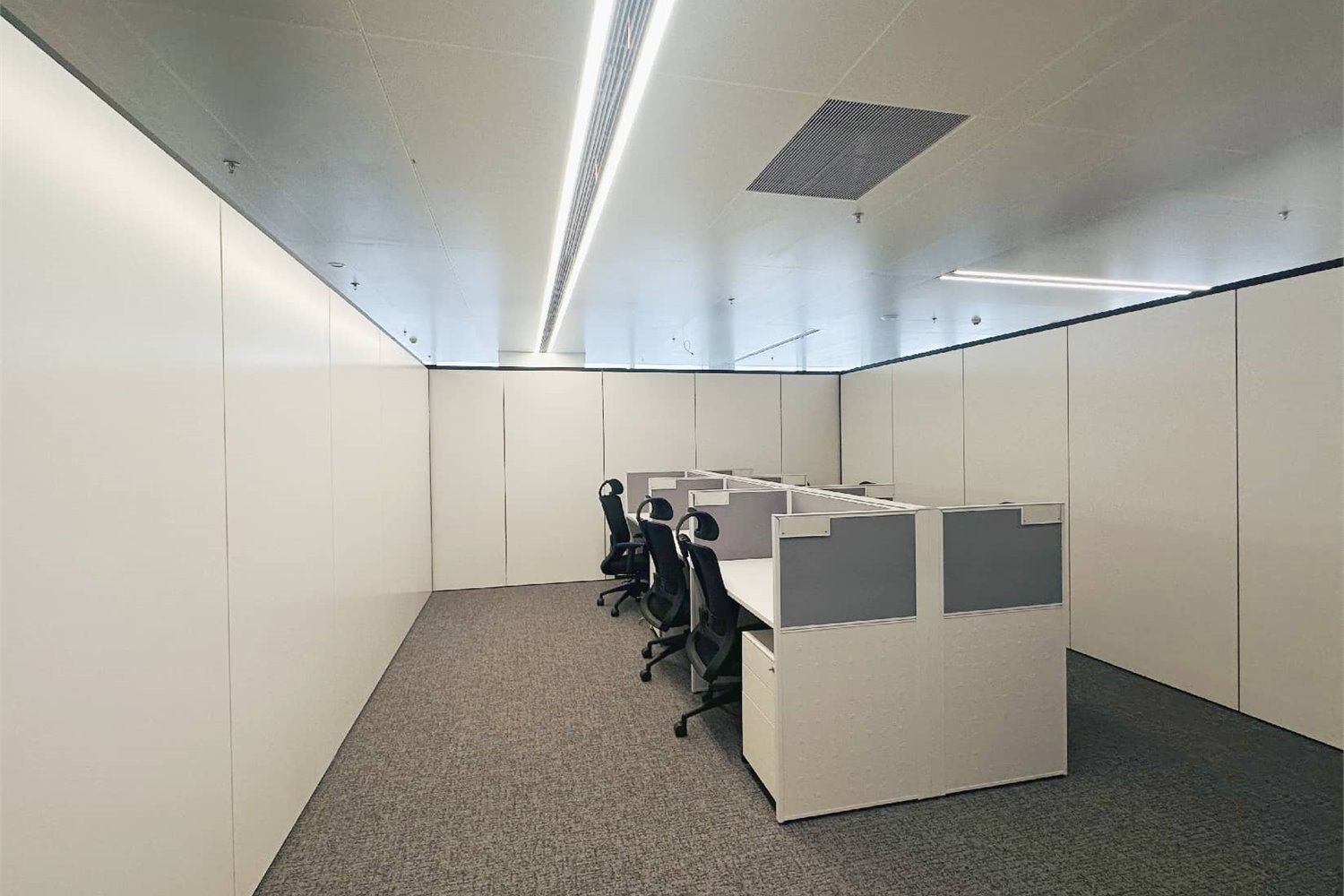
The PipeChina Shanghai Branch Office project used an INDEE 108 steel partition wall for meeting room, executive office, and open office areas. The project data includes a target around 42 dB, about 2.4 m height, galvanized steel panels, and powder-coated finish.
| Reference project | PipeChina Shanghai Branch Office |
|---|---|
| Application | meeting room, executive office, and open office area |
| System | INDEE 108 Steel Partition Wall |
| Acoustic target | 42 dB |
| Height | 2.4 m |
| Frame material | aluminum alloy / carbon steel |
| Finish | baked paint steel panel / powder-coated |
3. Steel vs Glass vs Fire-Rated Partitions
Steel partitions are not automatically better than glass, and glass is not automatically more premium. The right choice depends on the room function. Glass systems are useful when transparency and openness matter. Fire-rated glass systems, such as the QRT Shanghai Office reference, are selected when transparency must be combined with a fire separation strategy. Steel systems are useful when durability, privacy, modularity, or a more solid appearance is the priority.
| Steel partition | Durable, solid, clean modular look, good for offices, technical spaces, public interiors, and archive-style applications. |
|---|---|
| Glass partition | Transparent, modern, visually open, useful for meeting rooms and executive areas. |
| Fire-rated glass partition | Used when transparency and fire separation must be coordinated as a complete system. |
| Movable partition | Used when the room layout must change and panel parking/operation are required. |
4. What to Confirm Before Quotation
- Clear opening dimensions and whether the partition is full-height or partial-height.
- Acoustic target or expected privacy level.
- Panel material, thickness, finish, color, and replacement requirements.
- Door openings, hardware, access control, and interface with glass or fixed walls.
- Floor, ceiling, and wall substrate conditions.
- Whether the space needs future modification or modular replacement.
5. Common Mistakes in Steel Partition Procurement
- Comparing only panel price. The frame system, door detail, finish durability, and installation method can change the real value.
- Ignoring acoustic interfaces. A solid panel still needs proper perimeter sealing and surrounding construction.
- Choosing finish without maintenance review. Public or high-use spaces need surfaces that can tolerate cleaning and repair.
- Forgetting coordination with doors and glass. Many commercial interiors combine steel, glass, and doors in one system.
- Waiting too long to confirm dimensions. Modular panels depend on accurate opening and interface details.
How to Judge Whether a steel partition wall Proposal Is Serious
A professional partition proposal should do more than repeat a product name and a square-meter price. For commercial projects, the supplier should connect the system selection to drawings, opening dimensions, acoustic target, finish expectations, operation method, panel parking, and installation conditions.
If a supplier can only quote from a rough area number, the price may still be useful for early budgeting, but it should not be treated as a final technical proposal. The final recommendation should explain why a certain system, frame depth, track route, seal configuration, glass or panel specification, and finish package is suitable for the project.
| Budget price | Useful for early feasibility, but usually based on limited information and should be treated as a rough reference. |
|---|---|
| Technical proposal | Should be based on drawings, opening dimensions, acoustic target, operation method, finish, parking, and interface conditions. |
| Engineering review | Should identify risks such as ceiling conflicts, weak surrounding construction, insufficient parking space, or unclear door/hardware details. |
| Quotation confidence | Improves when the buyer provides plans, sections, reflected ceiling drawings, site photos, and required performance targets. |
This is also why INDEE prefers drawing-based communication before final pricing. A more careful early review reduces later design changes, acoustic disappointment, installation conflict, and unclear responsibility between supplier, contractor, and project owner.
6. Related INDEE Project References
FAQ: Steel Partition Wall Systems
Are steel partitions only for industrial spaces?
No. Steel partitions can be used in commercial offices, public facilities, archives, technical rooms, and modern interiors where a durable, precise, and solid wall system is preferred.
Can steel partitions provide acoustic privacy?
Yes, but acoustic performance depends on the complete assembly: panel structure, frame, seals, floor and ceiling interfaces, and surrounding construction.
What information should be sent for quotation?
Send drawings, opening dimensions, acoustic target, finish preference, door requirements, site photos if available, and any interface details with glass walls or other partition systems.
Send Drawings for a Project-Based Recommendation
If your project involves hotel ballrooms, convention centers, corporate offices, clean rooms, archives, or other flexible commercial spaces, INDEE can review the opening conditions and recommend a suitable partition system. Share drawings, target acoustic rating, opening size, finish preference, and panel parking requirements so the proposal matches the actual building instead of a generic product list.
