

11 Apr Flexible Partition Systems for Corporate Offices
Flexible Partition Systems for Corporate Offices
Content basis: This guide is based on INDEE project records, operable partition specifications, and commercial flexible-space project experience.
Last updated: April 2026. Final acoustic and system selection should be confirmed with project drawings, site conditions, and local requirements before quotation.
Quick answer: Choose glass office partitions by room function first: slim visual separation, meeting-room privacy, executive office performance, or movable glass flexibility.
In this guide:
- When INDEE 36 slim glass makes sense.
- How INDEE 84 and INDEE 90 support stronger office privacy.
- When movable glass is more suitable than fixed glass.
Glass office partition systems are often selected for transparency and modern workplace design, but the correct system depends on more than appearance. A slim meeting room, an executive office, and a movable glass partition all have different technical requirements.
INDEE project data shows three useful office directions: INDEE 36 for slim visual detail, INDEE 84 for stronger fixed glass privacy, and INDEE 90 for higher acoustic or movable glass applications. The right choice depends on frame profile, acoustic target, glass configuration, door detail, and whether the room needs future flexibility.
1. Start With the Room Function
Before comparing frame sizes, buyers should define the room use. A phone booth, meeting room, executive office, training room, and movable glass wall do not have the same acoustic, privacy, and operation requirements.
- Use slim profiles when transparency and visual lightness are the main goals.
- Use stronger fixed systems when meeting privacy and daily office use matter more.
- Use movable glass partitions when the layout must change after installation.
- Discuss doors, hardware, seals, frame color, and ceiling interface at the same time as glass type.
2. INDEE 36 for Slim Visual Detail
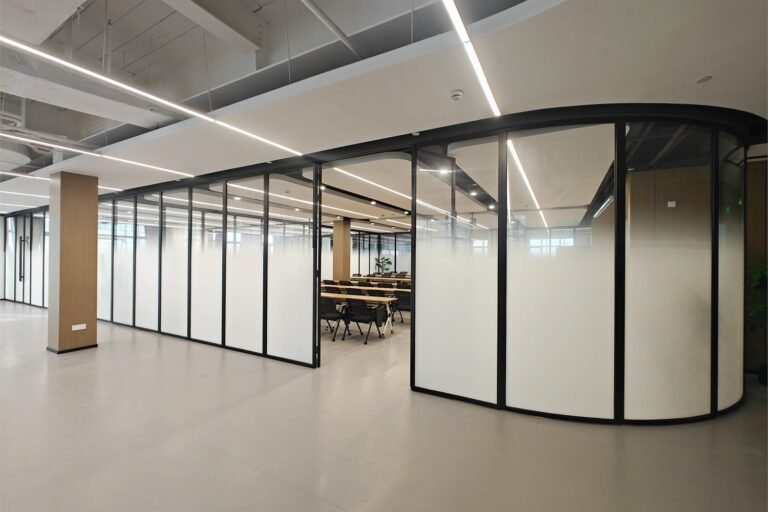
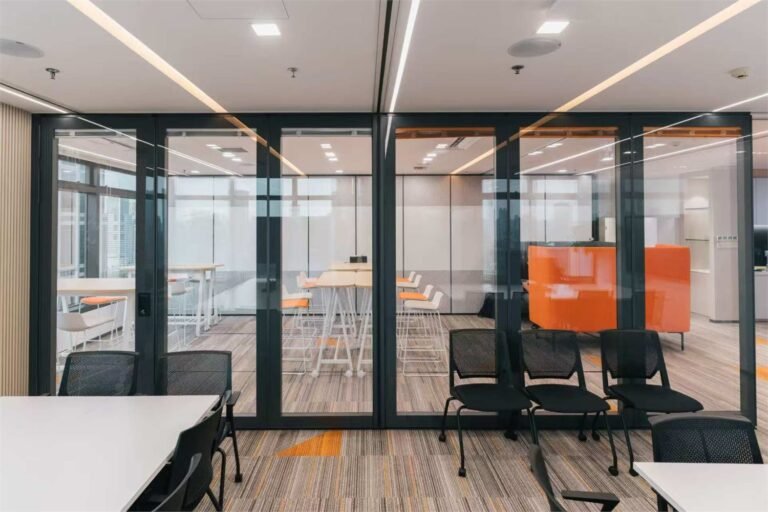
The Shanghai Minhang United Development Office project used an INDEE 36 slim glass partition wall for a meeting room application. The system included single glazed tempered glass, a 36mm profile, black frame, and gradient film on glass.
This type of solution is useful when the project priority is a clean line, open visual feeling, and modern office appearance. It is not always the right choice when strong acoustic privacy is the main requirement.
3. INDEE 84 and INDEE 90 for Stronger Office Privacy
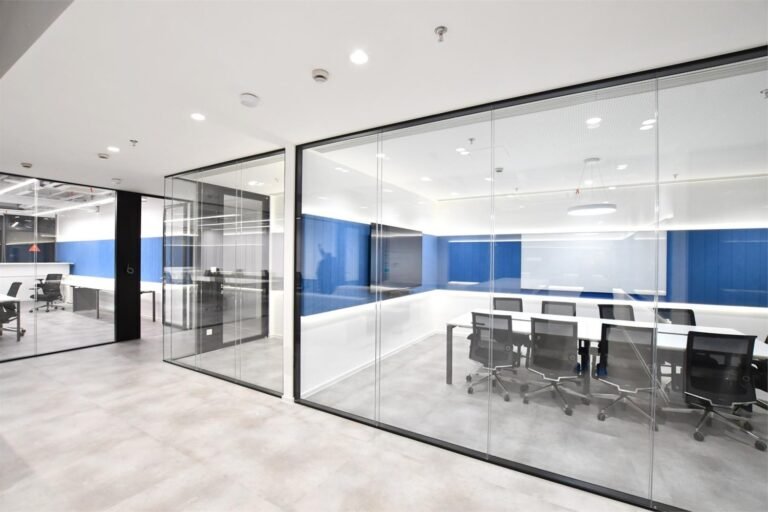
Guosheng Tower Office used an INDEE 84 system with about 44 dB. Atlas Copco Songjiang Office and Guohua Life Shanghai Headquarters used INDEE 90 systems around 45 dB.
These references fit corporate offices where meeting privacy and clean details both matter. The wider profile and glass configuration can support stronger performance than ultra-slim visual systems. For executive rooms, conference rooms, or management offices, this balance may be more important than choosing the narrowest possible frame.
| INDEE 36 | 36mm profile, slim visual detail, meeting room application. |
|---|---|
| INDEE 84 | 44 dB target in the Guosheng Tower Office reference. |
| INDEE 90 | 45 dB target in multiple corporate office references. |
| Movable glass reference | INDEE 90, 45 dB target, 3 m high x 15 m wide. |
4. Movable Glass for Flexible Layouts
SciClone Pharmaceuticals Shanghai Office used an INDEE 90 with about 45 dB, 3 m height, and about 15 m opening width. This is a different category from fixed glass because it must move, seal, and park correctly.
Movable glass partitions are useful when a company wants transparent rooms that can change layout. In this case, track, parking, seals, and operation method need as much attention as the glass itself.
5. What to Compare Before Choosing
| Visual profile | Frame width, visible mullions, color, corner details, and door frame design. |
|---|---|
| Acoustic target | Expected speech privacy, meeting frequency, and surrounding room noise. |
| Glass configuration | Single or double glass, tempered glass, laminated glass, film, gradient effect, or privacy treatment. |
| Door and hardware | Swing door, sliding door, access control, hinges, handles, and lockset finish. |
| Movability | Fixed partition or movable glass wall, track path, parking, and operation method. |
| Maintenance | Cleaning, hardware adjustment, seal durability, and future layout changes. |
6. Common Mistakes in Office Glass Partition Selection
- Choosing the slimmest frame by default. A slimmer profile may not meet stronger acoustic or hardware requirements.
- Ignoring door performance. Doors are often the weak point for both acoustic privacy and daily durability.
- Treating movable glass like fixed glass. Movable systems need track, parking, seals, and operating workflow.
- Comparing only glass thickness. Acoustic privacy depends on the full assembly, not glass thickness alone.
- Forgetting visual privacy. Transparent glass may need film, gradient treatment, blinds, or layout planning.
How to Judge Whether a glass office partition Proposal Is Serious
A professional partition proposal should do more than repeat a product name and a square-meter price. For commercial projects, the supplier should connect the system selection to drawings, opening dimensions, acoustic target, finish expectations, operation method, panel parking, and installation conditions.
If a supplier can only quote from a rough area number, the price may still be useful for early budgeting, but it should not be treated as a final technical proposal. The final recommendation should explain why a certain system, frame depth, track route, seal configuration, glass or panel specification, and finish package is suitable for the project.
| Budget price | Useful for early feasibility, but usually based on limited information and should be treated as a rough reference. |
|---|---|
| Technical proposal | Should be based on drawings, opening dimensions, acoustic target, operation method, finish, parking, and interface conditions. |
| Engineering review | Should identify risks such as ceiling conflicts, weak surrounding construction, insufficient parking space, or unclear door/hardware details. |
| Quotation confidence | Improves when the buyer provides plans, sections, reflected ceiling drawings, site photos, and required performance targets. |
This is also why INDEE prefers drawing-based communication before final pricing. A more careful early review reduces later design changes, acoustic disappointment, installation conflict, and unclear responsibility between supplier, contractor, and project owner.
7. Related INDEE Project References
FAQ: Glass Office Partition Systems
Which glass office partition system is best for meeting rooms?
It depends on the balance between visual openness and acoustic privacy. Slim systems suit transparency-first spaces, while INDEE 84 or INDEE 90 style systems are more suitable when stronger privacy is required.
When should buyers choose movable glass instead of fixed glass?
Movable glass is useful when the office layout needs to change after installation. It requires track, parking, sealing, and operation planning, so it should be specified earlier than a simple fixed glass wall.
What details affect the look of a glass office partition?
Frame width, glass type, frame color, door hardware, film or finish treatment, and ceiling/floor interfaces all affect the final appearance.
Send Drawings for a Project-Based Recommendation
If your project involves hotel ballrooms, convention centers, corporate offices, clean rooms, archives, or other flexible commercial spaces, INDEE can review the opening conditions and recommend a suitable partition system. Share drawings, target acoustic rating, opening size, finish preference, and panel parking requirements so the proposal matches the actual building instead of a generic product list.
