

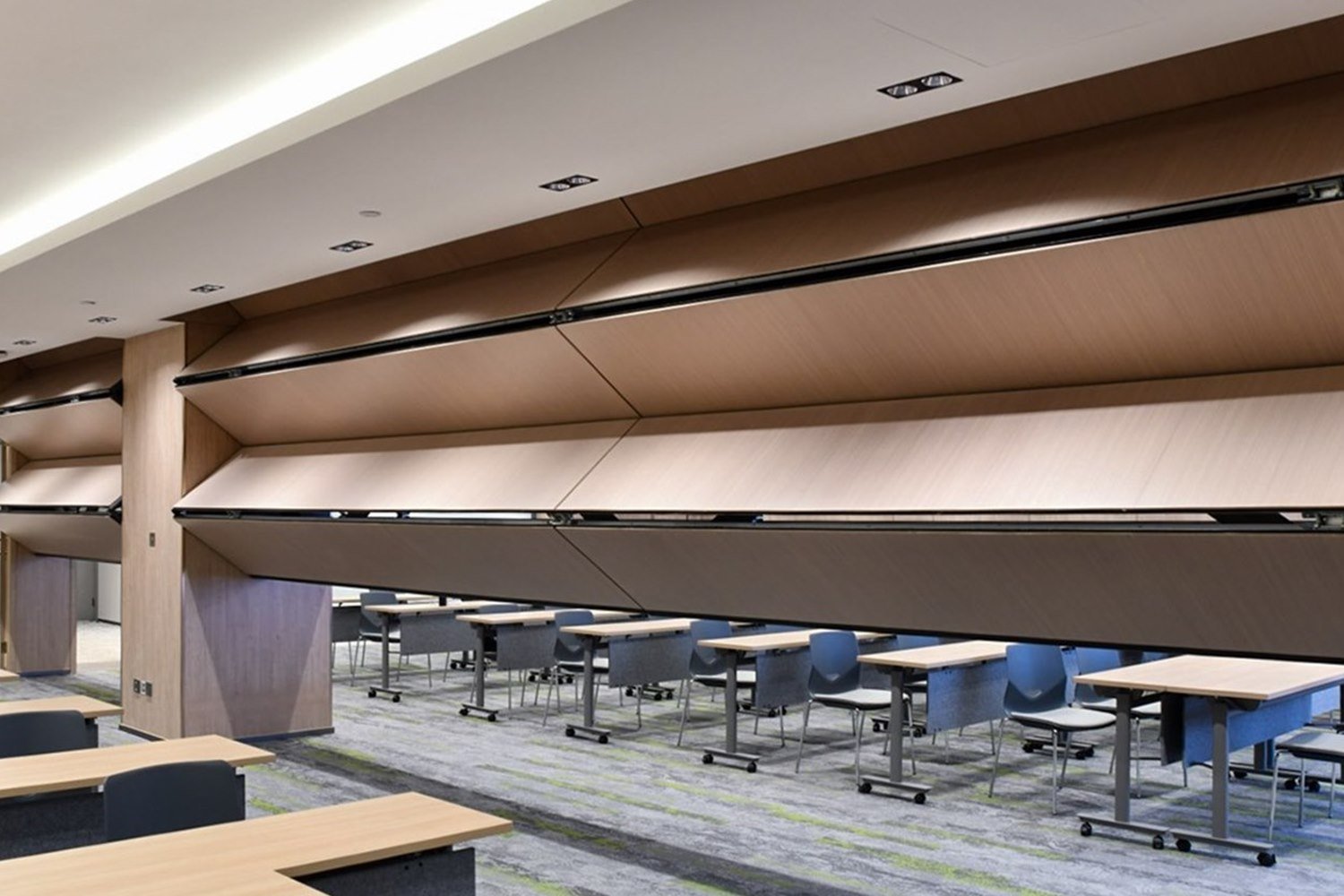
07 Apr Movable Wall Systems for Convention Centers
Movable Wall Systems for Convention Centers
Content basis: This guide is based on INDEE project records, operable partition specifications, and commercial flexible-space project experience.
Last updated: April 2026. Final acoustic and system selection should be confirmed with project drawings, site conditions, and local requirements before quotation.
Quick answer: Ultra-high operable walls should be treated as engineering systems because 10 m openings affect panel rigidity, track loading, acoustic sealing, parking, and installation sequence.
In this guide:
- Why ultra-high walls are different from standard movable walls.
- How real 10 m INDEE references shape the specification.
- What convention center buyers should confirm before procurement.
Convention centers and exhibition venues often need one hall to become several smaller rooms without permanent construction. Ultra-high operable partitions for convention centers make that flexibility possible, but they are not ordinary movable walls enlarged to a bigger size.
When the opening height reaches around 10 m, the project becomes an engineering coordination task. The system must address panel rigidity, track loading, acoustic sealing, parking layout, safety, installation tolerance, and long-term operation.
1. Why Ultra-High Walls Are Different
A standard movable wall can often be discussed around finish, acoustic target, and basic dimensions. An ultra-high wall requires earlier coordination because height changes panel structure, suspension, seal pressure, movement stability, and installation method.
- Taller panels need stronger internal structure and more stable vertical alignment.
- Track loading must be coordinated with the building structure and ceiling design.
- Panel parking needs enough depth, turning space, and safe operating route.
- Acoustic gaps become more visible in large-volume public halls.
- Operation and maintenance training matter because venue staff will move the system repeatedly.
2. Real Project Dimensions Shape the System
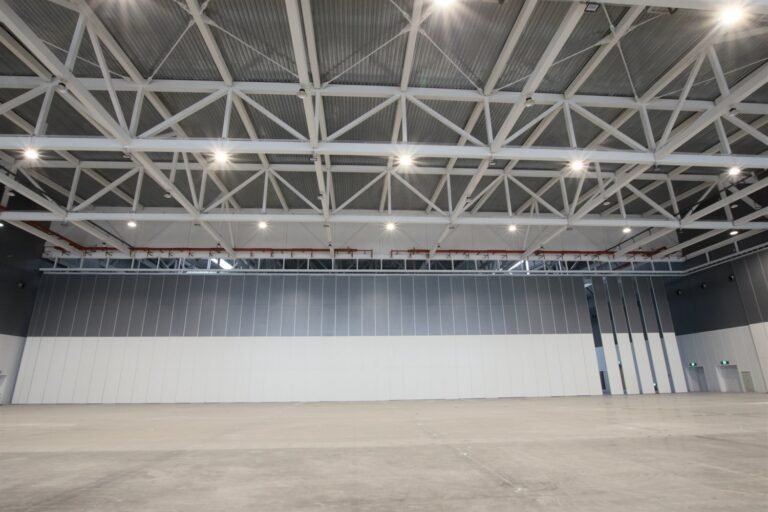
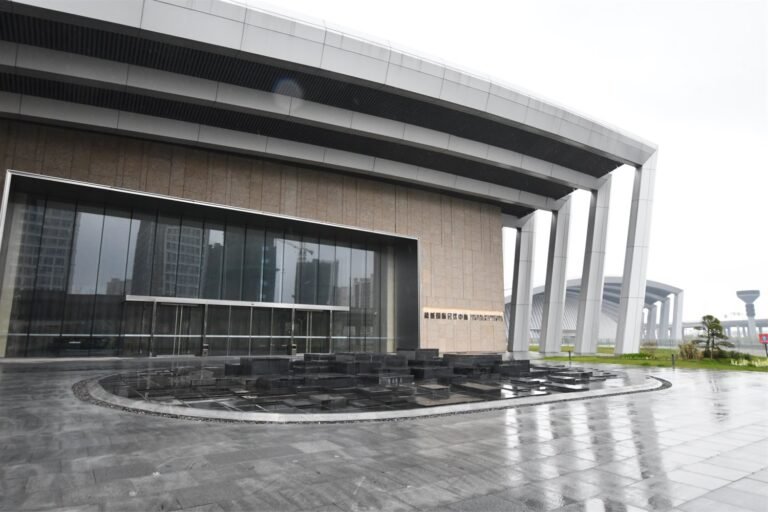
The Shaoxing Convention Center project used an INDEE 100 ultra-high operable partition wall with a target around 55 dB, approximately 10 m height and 36 m opening width. The Yancheng Yellow Sea Wetland Convention Center reference used a similar INDEE 100 ultra-high system with about 10 m height and 32 m width.
| Shaoxing Convention Center | INDEE 100, 55 dB target, 10 m high x 36 m wide, 37 panels panels. |
|---|---|
| Yancheng Yellow Sea Wetland Convention Center | INDEE 100, 55 dB target, 10 m high x 32 m wide. |
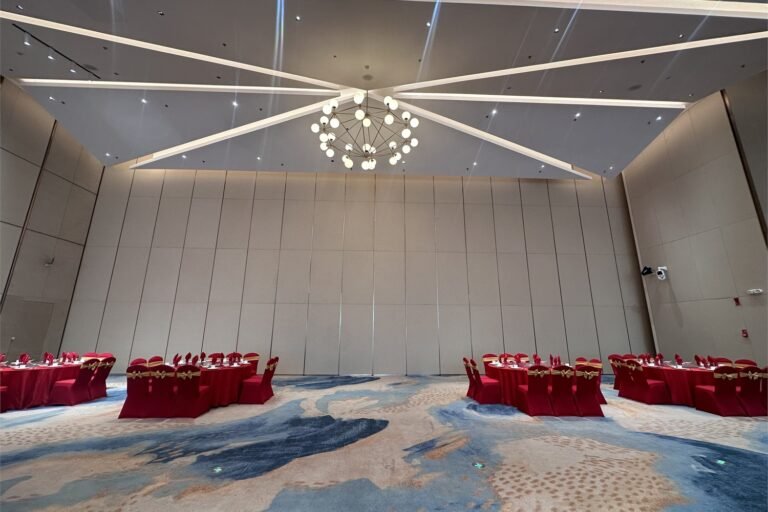
| Hotel comparison | INDEE 97, 53 dB target, 8.5 m high x 23 m wide. |
3. Track and Structure Coordination
The track carries the panel load, guides movement, and determines where panels can park. For ultra-high walls, the track should be coordinated with structural beams, suspension points, ceiling systems, lighting, sprinklers, speakers, smoke-control elements, and maintenance access.
If track coordination is delayed until the ceiling is already designed, the venue may face expensive redesign or compromised panel parking. For large public venues, this is one of the most important early-stage decisions.
4. Panel Parking Is an Operational Decision
When a convention hall is open, the panels must park safely and conveniently. Poor parking design can reduce usable exhibition space, block service routes, interfere with event setup, or slow down staff during turnover.
- Plan panel parking before ceiling drawings are frozen.
- Confirm panel route, turning point, stack depth, and storage pocket width.
- Check conflicts with doors, AV equipment, air diffusers, sprinklers, and access panels.
- Review how venue staff will open, close, and store the panels during events.
- Leave enough working space for maintenance and adjustment.
5. Acoustic Performance Depends on the Complete Assembly
A target such as 55 dB requires more than heavy panels. It depends on top seals, bottom seals, vertical seals, panel joints, side jambs, surrounding fixed walls, floor levelness, and commissioning. In a large hall, even small gaps can become noticeable because room volume and sound energy are high.
6. Procurement Checklist for Convention Centers
| Opening data | Clear opening height and width, not only general hall dimensions. |
|---|---|
| Structural drawings | Beam or suspension information above the track line. |
| Ceiling plan | Lighting, sprinklers, speakers, smoke detection, access panels, and MEP conflicts. |
| Acoustic target | STC/dB target or simultaneous event use scenario. |
| Parking plan | Storage pocket position, route, turning space, and daily operation plan. |
| Finish and durability | Panel surface, edge details, cleaning, repair, and long-term venue use. |
| Installation plan | Site access, lifting method, sequence, commissioning, and staff training. |
How to Judge Whether a ultra-high operable partition Proposal Is Serious
A professional partition proposal should do more than repeat a product name and a square-meter price. For commercial projects, the supplier should connect the system selection to drawings, opening dimensions, acoustic target, finish expectations, operation method, panel parking, and installation conditions.
If a supplier can only quote from a rough area number, the price may still be useful for early budgeting, but it should not be treated as a final technical proposal. The final recommendation should explain why a certain system, frame depth, track route, seal configuration, glass or panel specification, and finish package is suitable for the project.
| Budget price | Useful for early feasibility, but usually based on limited information and should be treated as a rough reference. |
|---|---|
| Technical proposal | Should be based on drawings, opening dimensions, acoustic target, operation method, finish, parking, and interface conditions. |
| Engineering review | Should identify risks such as ceiling conflicts, weak surrounding construction, insufficient parking space, or unclear door/hardware details. |
| Quotation confidence | Improves when the buyer provides plans, sections, reflected ceiling drawings, site photos, and required performance targets. |
This is also why INDEE prefers drawing-based communication before final pricing. A more careful early review reduces later design changes, acoustic disappointment, installation conflict, and unclear responsibility between supplier, contractor, and project owner.
7. Related INDEE Project References
FAQ: Ultra-High Operable Partitions
What makes an ultra-high operable partition different from a standard movable wall?
Ultra-high systems involve larger panel height, stronger track loading, more demanding alignment, and more complex parking coordination. The engineering risk is higher, so drawings and site conditions must be reviewed early.
Can a 10 m high movable wall achieve strong acoustic separation?
A strong target such as 55 dB can be planned, but it depends on the complete system and installation quality, including panel structure, seals, side jambs, surrounding walls, and commissioning.
When should the supplier join the project?
Preferably before ceiling and MEP coordination is frozen. Track route, panel parking, and structural support are easier to solve during design development than during site installation.
Send Drawings for a Project-Based Recommendation
If your project involves hotel ballrooms, convention centers, corporate offices, clean rooms, archives, or other flexible commercial spaces, INDEE can review the opening conditions and recommend a suitable partition system. Share drawings, target acoustic rating, opening size, finish preference, and panel parking requirements so the proposal matches the actual building instead of a generic product list.
